
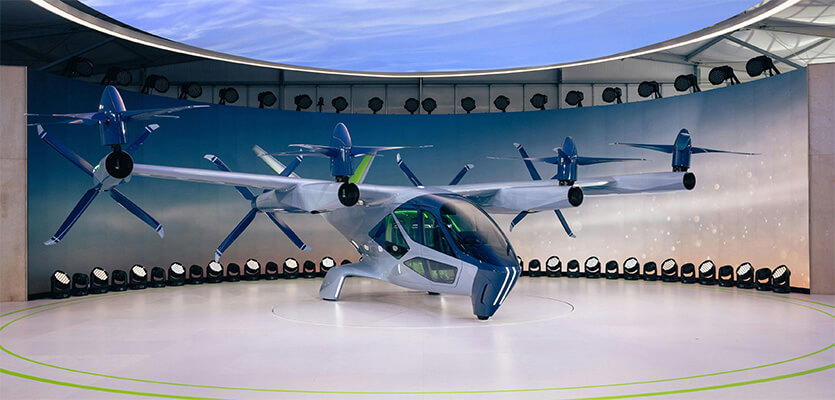
Table of contents:
What is an eVTOL? ∙ VTOL vs eVTOL ∙ How They Work ∙ eVTOL vs Helicopter vs Plane ∙ The Battery Challenge ∙ Different Designs ∙ Potential Uses ∙ FAQs ∙ Planning for the Future
If you’ve heard the term “flying taxi” or “air taxi” and wondered what it actually means, you’re not alone. eVTOL is one of those acronyms that seems to appear everywhere lately—but what exactly is an eVTOL, and why is everyone talking about it?
What is an eVTOL?
eVTOL stands for electric vertical takeoff and landing. Let’s break that down:
- Electric: The aircraft runs on batteries and electric motors, not jet fuel or gasoline.
- Vertical: It can go straight up and straight down, eliminating the need for a traditional runway.
- Takeoff and Landing: Just like any aircraft, but with a much smaller footprint.
Think of it as combining the vertical flight capability of a helicopter with some of the efficiency of an airplane, all powered by electricity. eVTOLs have the potential to provide quieter, lower-emission transportation for people and cargo in cities and beyond.
VTOL vs eVTOL: What's the Difference?
You’ll often see “VTOL” and “eVTOL” used interchangeably, but they’re not quite the same thing. VTOL stands for vertical takeoff and landing. It’s the umbrella term for any aircraft that can go straight up and straight down without needing a runway.
Think of it as a capability, not a specific type of machine. Some examples of VTOL aircraft are:
- Helicopters (the most common VTOL aircraft today)
- Vectored-thrust jets (e.g., Harrier Jump Jet) which can direct engine thrust downward for vertical lift
- Tiltrotors (e.g., V-22 Osprey): Aircraft with rotors that tilt for vertical and forward flight
- And yes, eVTOLs—but they’re just one subset of the larger VTOL family
So where does eVTOL fit in? eVTOLs are one type of VTOL aircraft that use electric propulsion rather than conventional fuel.
How Do eVTOLs Work?
The magic of an eVTOL is in how it transitions between two very different flight modes. Unlike a traditional airplane that needs a runway, or a helicopter that relies on a single giant rotor, eVTOLs use electric propulsion systems and a variety of rotor, propeller, or lift configurations to make this happen.
Vertical Takeoff and Hover
During takeoff, the eVTOL’s rotors point upward, generating the thrust needed to lift the aircraft straight off the ground. This is similar to how a drone or helicopter works, but instead of one large rotor, eVTOLs use distributed electric propulsion—multiple smaller rotors spread across the aircraft. This configuration can also provide propulsion redundancy, depending on the aircraft’s design.
Transition to Forward Flight
Once the aircraft reaches cruising altitude, it transitions to forward flight. Depending on the design, some rotors tilt forward, or separate cruise propellers take over. As the aircraft gains speed, its fixed wings generate lift like a traditional airplane, making forward flight much more energy-efficient than hovering .
Electric Propulsion
Everything runs on advanced lithium-ion batteries that power the electric motors. Electric motors have fewer moving parts than traditional gas turbine engines, which can simplify propulsion systems and maintenance. Electric propulsion can also help reduce noise during operation.
eVTOL vs Helicopter vs Plane: Quick Comparison
The easiest way to understand what an eVTOL is, is to see how it compares to what we already know.
Feature | eVTOL | Helicopter | Traditional Airplane |
|---|---|---|---|
Takeoff | Vertical | Vertical | Requires runway |
Power Source | Electric (batteries) | Jet fuel or gasoline | Jet fuel |
Noise Level | Generally lower noise potential | Higher noise levels | Moderate (louder at takeoff) |
Emissions | No direct emissions during flight | Produces direct emissions | Produces direct emissions |
Safety Redundancy | Can incorporate propulsion redundancy | Single main rotor system | Varies by aircraft |
Primary Use | Urban air taxis, cargo | Transport, rescue, military | Long-distance passenger/cargo |
The Biggest Challenge: Battery Energy Density
If eVTOLs are so great, why aren’t they everywhere yet? The short answer: batteries.
Batteries are heavy, and they don’t store nearly as much energy per pound as jet fuel. This is called energy density, and it remains one of the industry’s biggest technical challenges.
Consider this: Jet fuel stores about 12,000 Wh/kg of energy, while today’s advanced lithium-ion batteries offer roughly 200-260 Wh/kg. That means a battery weighing 60 pounds might hold the same energy as one pound of jet fuel.
This weight creates a “chicken and egg” problem: adding more batteries increases range, but also adds weight, which requires more power, which needs… more batteries . As a result, many early eVTOL concepts are focused on shorter regional or urban trips, depending on the aircraft’s design and payload.
However, battery technology is improving rapidly, and many experts see this as a solvable problem in the coming years.
Different Types of eVTOL Designs
Not all eVTOLs look the same. Manufacturers are testing several different configurations, each with pros and cons.
Multirotor
This is the simplest design—like a giant drone. All rotors are fixed in place and used for both takeoff and forward flight.
- Pros: Simple, maneuverable, easy to control.
- Cons: Poor energy efficiency and limited range because there are no wings for lift during cruise.
- Use case: Short-range air taxis, small cargo delivery.
Lift + Cruise
This design uses separate sets of rotors: some for vertical lift, and a dedicated propeller for forward cruise flight. Fixed wings provide lift during cruise, making it much more efficient than multirotor.
- Pros: Better range and efficiency than multirotor.
- Cons: More complex design, heavier (two separate propulsion systems).
- Use case: Passenger air taxis, regional transport.
Tiltrotor/Vectored-Thrust
In this design, the same rotors tilt from a vertical position (for takeoff) to a horizontal position (for forward flight). This is similar to how the military’s V-22 Osprey works.
- Pros: Potential for greater efficiency and range.
- Cons: Highly complex mechanical and control systems, expensive to develop and certify.
- Use case: Regional air services, longer-range passenger transport.
What Will eVTOLs Be Used For?
While passenger “air taxis” get the most attention, eVTOL aircraft have several other practical applications, such as:
Urban Air Taxis
This is the headline use case. The idea is to offer on-demand flights that bypass ground traffic, connecting city centers to airports or suburbs to downtowns. Passengers would book a flight via an app, similar to hailing a ride-share.
Cargo and Package Delivery
eVTOLs are well-suited for moving high-value or time-sensitive goods quickly. Companies are already exploring using eVTOLs for medical supply deliveries, e-commerce shipping, and logistics.
Emergency Response and Public Services
Emergency services are another potential application. Because they don’t need a runway and can land in tight spaces, eVTOLs could be used for:
- Medical transport: Rapidly moving patients or organs between hospitals.
- Search and rescue: Reaching people in remote or dangerous terrain where helicopters can’t go or are too expensive.
- Disaster response: Delivering supplies to areas cut off by floods, fires, or earthquakes.
As eVTOL operations develop, existing airports and heliports may provide some of the infrastructure needed for early operations, while new vertiports and other specialized facilities may support future growth.
Frequently Asked Questions
How quiet is an eVTOL compared to a helicopter?
Some eVTOL aircraft are designed to operate more quietly than conventional helicopters. One study found that an eVTOL produced noise above ambient levels over 0.17 square miles, compared with 45 square miles for a helicopter on the same route. These findings highlight the potential for quieter eVTOL operations in densely populated areas.
Can eVTOLs fly autonomously?
Some eVTOL developers are exploring autonomous or highly automated flight, but early commercial operations are expected to involve pilots. The technology and regulatory framework for autonomous operations are still developing.
When will eVTOLs be available for public use?
eVTOL aircraft are already undergoing testing and certification. Ultimately, the timing of commercial passenger operations will vary by aircraft, operator, location, and regulatory approvals.
Planning for the Future of eVTOL Aviation?
If you’re considering developing a landing site for these next-generation aircraft, we can help. Contact us for a site review to explore what your property might need—whether that’s a helipad, heliport, or vertiport. We’re here to help you plan for the future of aviation.
Explore More Topics
If you found this intro helpful, check out these related articles: