
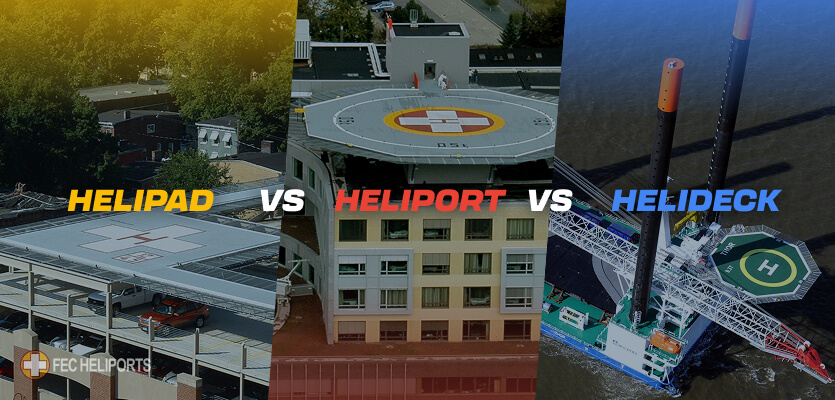
Understanding the Key Differences
If you’ve ever searched for information about helicopter landing zones, you’ve probably seen the terms helipad, heliport, and helideck used interchangeably.
The confusion is completely understandable.
They all relate to helicopter takeoffs and landings, but they differ in how they’re designed, where they’re used, and what supporting infrastructure they may include.
So, which one do you actually need?
Let’s break down each term clearly—and yes, we’ll also tackle that burning question you’re probably already asking: Can you land a helicopter anywhere? (Spoiler: The answer is more complicated than you think.)
Heli Comparison Table
Feature | Helipad | Heliport | Helideck |
|---|---|---|---|
Best defined as | A designated helicopter landing or parking area
| A helicopter landing facility with associated infrastructure
|
A specialized helicopter landing area on a structure, often used in marine/offshore operations
|
Primary Location | Rooftops, hospitals, private estates, remote areas
| Standalone facilities or part of larger airports
| Offshore oil rigs, FPSOs (floating production vessels), OSVs (supply ships), and SOVs (wind farm service vessels)
|
Key Features | Marked “H,” basic lighting
| May include fueling stations, maintenance facilities, passenger areas, and other operational support services | Marine-grade fire suppression, corrosion-resistant materials, heavy-duty securing systems
|
Typical Users | Medevac, corporate transport, private owners
| Urban commuter hubs, news/media fleets, scheduled helicopter services
| Offshore energy workers, marine logistics, search-and-rescue
|
Understanding Helipads
Think of a helipad as a general-purpose helicopter landing pad.
It is a flat, designated surface—either at ground level or elevated on a rooftop—that allows a helicopter to take off, land, or park safely.
Where will you find them?
- Hospital rooftops (for emergency medevac flights).
- Corporate campuses (for executive transport).
- Private estates (for high-net-worth individuals).
- Remote locations (for search-and-rescue or utility operations).
What makes them unique?
- Marked with a large, highly visible “H.”
- May include basic perimeter lighting for nighttime operations.
- Typically does not include additional facilities like fueling, maintenance, or passenger services; it serves primarily as a designated helicopter landing area.
When do you need a helipad?
A helipad may be a good option when you need occasional helicopter access without extensive support facilities. It can provide a practical, space-efficient solution depending on your site and operational needs.
Understanding Heliports
A helipad is a designated area for helicopter landing or parking, while a heliport is a broader facility that may include one or more landing areas along with additional infrastructure and support services.
Where will you find them?
- Standalone facilities in densely populated urban areas.
- As part of larger international airports (integrated with fixed-wing operations).
- Dedicated hubs for news media, emergency services, or commuter helicopter networks.
What makes them unique?
- One or more designated helicopter landing areas.
- Fueling stations for quick turnarounds.
- Maintenance and hangar facilities for aircraft storage and repairs.
- Passenger amenities such as waiting areas or check-in counters.
- Other operational support services, depending on the facility.
When do you need a heliport?
A heliport can provide the additional landing areas and support infrastructure if you need to accommodate more complex, higher-volume operations—think urban air taxi services, news fleets, or scheduled commuter routes.
Understanding Helidecks
A helideck is a more specialized landing area commonly used in offshore and marine environments.
Where will you find them?
- Oil and gas rigs — fixed platforms in the middle of the ocean.
- Floating production storage and offloading vessels (FPSOs) — floating facilities that extract and store oil at sea.
- Offshore support vessels (OSVs) — ships that transport equipment, supplies, and crew to offshore installations.
- Service operation vessels (SOVs) — used to service offshore wind farms.
What makes them unique?
- Built to withstand extreme marine conditions (saltwater corrosion, high winds, constant motion).
- Equipped with marine-grade fire suppression systems (critical when you’re miles from shore).
- Includes helicopter securing systems to lock the aircraft down during rough seas.
When do you need a helideck?
If your operation involves offshore or marine activities, a helideck may be an appropriate landing solution for safely moving personnel and supplies.
Choosing the Right Landing Facility
Helipads, heliports, and helidecks all serve the same core function: providing a designated area for helicopter operations. But the right option depends on your location, future scalability, and infrastructure needs.
Here’s a simple way to compare your options:
- Operating in an offshore or marine environment? → A helideck may be the appropriate solution.
- Need occasional helicopter access without extensive support facilities? → A helipad may be the best fit.
- Managing higher-volume helicopter operations with additional support services? → A heliport may provide the infrastructure you need.
Frequently Asked Questions
Can a helipad be part of a heliport?
Yes. A helipad can be a designated landing or parking area within a larger heliport. A heliport may include one or more landing areas along with additional infrastructure and support facilities, depending on its purpose and design.
Is a helideck the same as a helipad?
A helideck is a specialized helicopter landing area on a structure, commonly used in offshore and marine environments. While a helipad can be located in a variety of settings, helidecks are designed to accommodate the specific conditions and operational needs of their environment.
Do I need approval to build a helipad?
Yes—but the specifics depend on your location, local zoning considerations, and applicable aviation criteria. That’s exactly why we recommend a site review before you break ground.
Find the Right Solution for Your Site
Still unsure which option is right for your operation? Contact us today for a professional site assessment. Our technicians can evaluate your location and help determine the appropriate infrastructure for your needs.
Explore More Topics
This post focused on helipads, heliports, and helidecks. But if you’re planning for the future of urban air mobility, you might also be interested in:
- What is a vertiport? — A deep dive into the facilities designed for electric air taxis.
- Helipad vs Vertiport: What’s the difference? — How traditional helipads compare to vertiports.