
Table of contents:
Terminology ∙ Aircraft Type & Facility Design ∙ Helipad vs Vertipad ∙ Design Considerations ∙ Power, Fuel, & Infrastructure ∙ Fire Protection & Site Safety ∙ Lighting & Markings ∙ Can Existing Heliports Accommodate VTOL Aircraft? ∙ Planning for Helicopters & VTOL Aircraft ∙ FAQs ∙ Preparing for Your Helipad or Vertipad
Terminology: Helipads, Vertipads, Heliports and Vertiports
Before getting into design considerations for helipads and vertipads, it helps to clarify the terminology. A helipad and vertipad describe landing areas, while a heliport and vertiport refer to the broader facilities that support those landing areas and aircraft operations. Because these terms are often used interchangeably, understanding the differences is an important first step.
The distinction between heliports and vertiports also matters. A vertiport is a type of heliport, but it includes additional design considerations for certain vertical takeoff and landing (VTOL) aircraft. The FAA’s Engineering Brief 105A (EB 105A) provides current guidance for vertiport design.
In this article, we’ll clarify these terms further and explore how aircraft type, site, and intended operations influence helipad and vertipad design.
How Aircraft Type Affects Facility Design
If you’re planning infrastructure for vertical flight, the first question is: What aircraft will the facility serve?
The type of aircraft a facility will serve is one of the first considerations in planning a helipad or vertipad. The aircraft you plan to accommodate can influence everything from site layout and landing-area geometry to electrical infrastructure, markings, safety planning, and future operations.
Traditional heliports are designed for helicopter operations. The FAA’s heliport guidance addresses aircraft with conventional rotor configurations, including single, tandem, and dual rotor helicopters.
Vertiport guidance addresses a newer category of VTOL aircraft. Under EB 105A, the FAA’s current design criteria apply to certain powered-lift and special-class rotorcraft with three or more propulsive units that meet the document’s reference-aircraft criteria.
Many of the aircraft being developed for Advanced Air Mobility (AAM) use electric propulsion and are commonly referred to as eVTOLs, or electric vertical takeoff and landing aircraft.
However, “vertiport” should not simply be read as another word for an electric-air-taxi landing pad. Aircraft designs, propulsion systems, operational models, and FAA guidance are all continuing to develop.
If you’re new to the technology, read our guide to What Is a Vertiport? for an introduction to vertiports and Advanced Air Mobility.
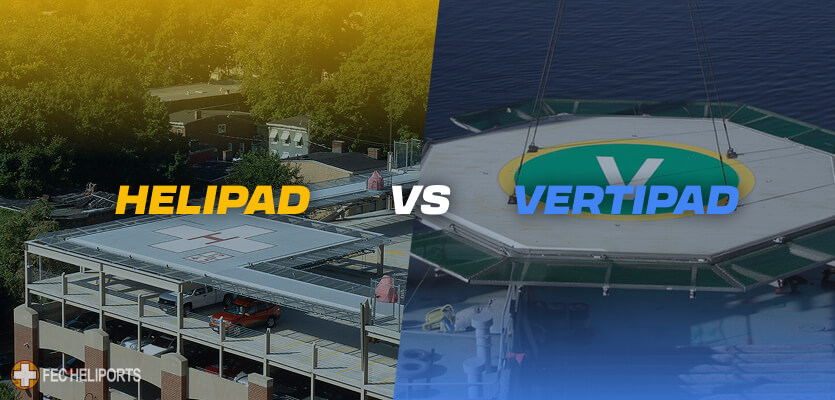
Helipad vs. Vertipad: Quick Comparison
Helipad | Vertipad | |
|---|---|---|
Primary Aircraft | Helicopters | Certain VTOL/powered-lift aircraft
|
Energy Infrastructure | May support aviation fueling infrastructure
| May require electric charging infrastructure for battery-powered aircraft
|
Landing-Area Design
| Designed around the intended helicopter and operation | Designed around the intended VTOL aircraft and current FAA vertiport criteria
|
Markings | Heliport identification markings
| “H” identification symbol plus “VTL” marking under current FAA guidance
|
Additional planning considerations
| Helicopter-specific operational and site criteria
| VTOL geometry, charging, parking, downwash/outwash, and other emerging standards
|
At the landing-area level, the distinction is between a helipad and a vertipad; at the facility level, the corresponding terms are heliport and vertiport. The right facility depends on the aircraft, operation, and site. If you’re specifically comparing a helipad and heliport, see our guide to Helipad vs. Heliport.
Design Considerations
The aircraft a helipad or vertipad is designed to serve directly affects its layout and infrastructure. While helicopters and VTOL aircraft share some fundamental design considerations, their criteria can differ.
A helipad project may need to consider elements such as the touchdown and liftoff area, final approach and takeoff area, safety area, approach and departure paths, structural standards, lighting, access, and the operational environment.
Many of those same fundamental concepts apply to vertipads, but the design criteria aren’t necessarily identical. The FAA’s updated EB 105A includes specific guidance for VTOL operations, including:
- Touchdown and Liftoff Areas (TLOF)
- Final Approach and Takeoff Areas (FATO)
- Safety areas
- Approach and departure paths
- VTOL parking
- Downwash and outwash
- Markings and lighting
- Charging and electrical infrastructure
- Site safety
One notable addition in the updated guidance is a Downwash/Outwash Caution Area (DCA). Because emerging VTOL aircraft can use different configurations and multiple propulsors, the airflow around the aircraft must be considered as part of site planning and keeping people, equipment, and other objects safely separated from operating areas.
These differences make early aircraft and site planning especially important. Project teams should evaluate the intended aircraft and operation before finalizing the helipad or vertipad design.
For more on the planning process, explore FEC’s helipad design and installation services or our resources for architects and project teams.
Power, Fuel, and Supporting Infrastructure
Another significant difference can be the infrastructure needed to support aircraft between flights. Some heliports include aviation fueling systems, while many do not. The guidelines depend on how the facility will be used. For battery-powered VTOL aircraft, access to electrical charging can become an important part of site planning.
The FAA notes that many AAM aircraft manufacturers are exploring electric batteries as an alternative energy source and that facility owners and operators will need to consider where and how charging equipment is incorporated into a vertiport or airport site.
That planning can go beyond installing a charger. Depending on the aircraft and operation, teams may need to evaluate:
- Available electrical capacity
Charging equipment location - Aircraft turnaround compliance
- Cable and equipment placement
- Battery storage, if applicable
- Emergency and backup power
- Compatibility with multiple aircraft or charging systems
- Future expansion
The FAA also notes that electrical needs vary by aircraft design and manufacturer and that industry standards are continuing to evolve. For a project team, that means energy infrastructure should be considered early in the design process, rather than treated as equipment that can simply be added later.
Fire Protection and Site Safety
Fire protection is important for both helipads and vertipads, but the appropriate system and safety strategy depend on the facility, aircraft, energy source, applicable codes, and intended operations.
For vertipads, FAA Engineering Brief 105A (EB 105A) directs project teams to NFPA 418, Standard for Heliports and Vertiports, for fire-protection guidance. It also references NFPA 855, Standard for the Installation of Stationary Energy Storage Systems, for energy-storage safety.
Battery-powered aircraft can introduce considerations around charging equipment and battery storage. The FAA recommends that batteries stored on-site be positioned away from operational landing and safety areas and handled in accordance with applicable building codes, fire codes, and NFPA standards.
Beyond fire protection, a complete safety plan may address:
- Access control for operational areas
- Emergency response procedures
- Caution areas that keep people and equipment clear of operational hazards
- Security standards
- Wind and turbulence considerations
- Weather information and operating conditions
- Winter operations
- Safe passenger access
These considerations work together to create a landing environment that supports safety and efficiency.
Lighting and Markings
Both helipads and vertipads rely on markings, lighting, and visual aids to help pilots identify and safely use the facility. But one detail in particular distinguishes a vertipad under current FAA guidance.
EB 105A specifies that vertipads use the familiar “H” heliport identification symbol, along with a “VTL” marking identifying the site. That means the difference isn’t simply replacing an “H” with a “V.” The current guidance also addresses elements including:
- TLOF markings
- Size and weight limitation markings
- Flight-path alignment markings
- Perimeter lighting
- Identification beacons
- Wind cones
FEC Heliports designs and manufactures complete helipad systems and supporting equipment, allowing these elements to be considered as part of the larger landing-site design.
Can an Existing Helipad Accommodate VTOL Aircraft?
Potentially. An existing helipad may be able to accommodate certain VTOL aircraft, but it must be evaluated based on the aircraft’s requirements and applicable FAA guidance. The FAA anticipates that early Advanced Air Mobility operations may use existing infrastructure, including heliports, where appropriate.
However, an existing helipad should not automatically be assumed to meet the design criteria for VTOL aircraft. The FAA’s EB 105A provides specific design guidance for facilities intended to accommodate certain VTOL aircraft, including factors such as:
- Load-bearing-area guidelines
- Landing-area sizing
- Downwash/outwash caution areas
- Site-safety elements
- Required vertiport markings
- Charging infrastructure, where applicable
It’s also important to distinguish the landing area from the broader facility (like we did earlier). A helipad or vertipad refers to the landing area itself, while a heliport or vertiport refers to the broader facility. An existing heliport may therefore contain a helipad that could potentially be adapted for VTOL operations, but compatibility must be evaluated based on the aircraft, site, infrastructure, and intended operations.
In short, an existing helipad can potentially accommodate VTOL aircraft, but compatibility should be evaluated rather than assumed.
Should You Plan for Helicopters, VTOL Aircraft, or Both?
For many project teams, the real question isn’t simply “helipad or vertipad” or “heliport or vertiport?”
It’s: What do we need today, and what might we want this facility to support in the future?
A hospital that relies on helicopter emergency medical transport has different operational priorities than a developer exploring future advanced air mobility (AAM) applications. Similarly, a property owner may want to know whether infrastructure designed for helicopter operations today could accommodate additional aircraft types as technology evolves.
There is no universal answer.
The right strategy depends on factors including:
- Current and anticipated aircraft
- Intended facility use
- Site conditions
- Rooftop or ground installation
- Available space
- Structural standards
- Utility and electrical capacity
- Approach and departure paths
- Local and federal criteria
- Long-term plans for the property
Considering these factors early can help project teams make informed decisions and preserve flexibility as operational needs change.
FEC Heliports brings decades of experience designing, manufacturing, and installing helicopter landing infrastructure for hospitals, commercial properties, offshore facilities, and other specialized applications. That experience provides a foundation for helping project teams evaluate their current needs while considering how evolving vertical-flight technology could influence future infrastructure decisions.
Frequently Asked Questions
Is a vertiport the same as a heliport?
Not exactly, but the terms are closely related. Under current FAA guidance, a vertiport is a type of heliport with distinct criteria for the VTOL aircraft covered by EB 105A. Traditional heliport guidance was developed around conventional helicopter configurations, while the vertiport guidance supplements those standards for emerging aircraft designs.
What’s the difference between a helipad and a vertipad?
A helipad is a landing area used for helicopter operations, while a vertipad is a landing area intended for certain vertical takeoff and landing (VTOL) aircraft. The design of either landing area depends on the aircraft, site, intended operations, and applicable criteria.
Are vertiports only for eVTOL aircraft?
Not necessarily. Many current Advanced Air Mobility aircraft concepts use electric propulsion, which is why eVTOLs and vertiports are often discussed together. However, FAA vertiport guidance is based on aircraft configuration and certification criteria rather than simply whether an aircraft is electric. The FAA is also studying other emerging energy sources and technologies.
Can helicopters use a vertiport?
Potentially. FAA EB 105A states that vertiports may accommodate helicopters that fit within the size and maximum takeoff weight limitations of the facility’s design VTOL aircraft. Actual compatibility should be evaluated for the specific facility and aircraft.
Can an existing heliport be converted into a vertiport?
Potentially. However, conversion isn’t simply a change in signage. Existing facilities should be evaluated against current FAA vertiport guidance, including landing-area design, safety considerations, markings, and other factors specific to the facility and aircraft.
Do all heliports have fueling stations?
No. Fueling depends on the purpose and operation of the facility. Some heliports include fuel infrastructure, while others function primarily as landing and takeoff facilities.
Do all vertiports need electric charging stations?
Not necessarily. Charging depends on the aircraft the facility intends to serve. Many current AAM concepts are battery-electric, which makes charging infrastructure an important planning consideration, but aircraft technology and energy systems continue to evolve.
Preparing for Your Helipad or Vertipad
The right landing facility depends on the aircraft you plan to accommodate, your site, current operational needs, and future plans. Whether you’re planning a new helipad or evaluating infrastructure for VTOL aircraft, early design decisions can help ensure the facility aligns with the project’s operational needs and applicable criteria. Contact FEC Heliports to discuss your project and determine what your facility may require.
Explore More Topics
If you’re planning infrastructure for vertical flight, you might also be interested in:
- Helipad vs Heliport vs Helideck — Understanding the infrastructure differences between a simple landing zone and a full-service facility.
- What is a vertiport? — A deep dive into the facilities designed for electric air taxis and the future of urban air mobility.
- All about eVTOLs — A guide to the various types of vertical take off and landing aircraft.