
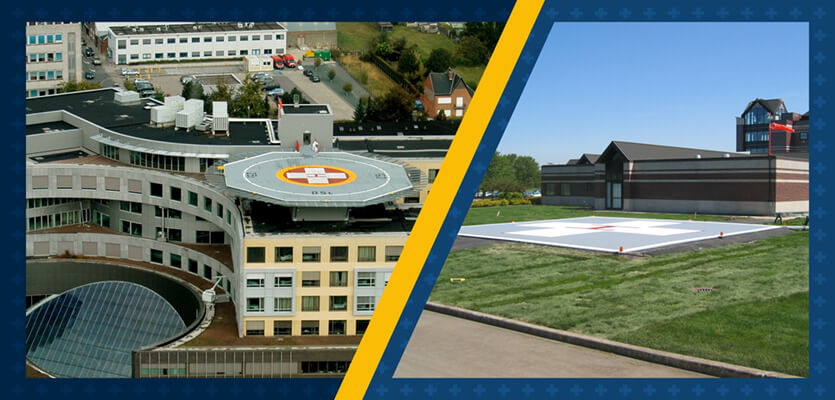
When planning a helicopter landing solution, one of the first decisions you’ll face is whether to build a rooftop helipad or a ground helipad. While both serve the same essential function, their design, construction, and operational considerations can differ significantly.
A rooftop helipad is a helicopter landing pad installed on top of a structure, while a ground helipad is built at surface level.
For healthcare facilities, architects, developers, and municipalities, this choice often comes down to space, cost, accessibility, and safety. Understanding the differences early in the planning process can help ensure your heliport aligns with operational needs and compliance criteria.
In this guide, we’ll break down the key differences between rooftop and ground helipads to help you determine the best fit for your project.
What Is a Rooftop Helipad?
A rooftop helipad is a helicopter landing pad installed on top of a building. These are most commonly found on hospitals and urban infrastructure, providing a clear landing zone free from obstructions and with minimal exposure to pedestrian or vehicle traffic. In some cases, ground space simply isn’t available, making the rooftop the only practical option. Beyond the space savings, rooftop helipads offer a critical advantage: direct, rapid access to the facilities below, which can make a life-or-death difference in emergency medical situations.
Considerations for a rooftop installation come down to three core areas: rooftop access, structural interface, and the surrounding building landscape. With FEC’s aluminum systems, the structural side is largely handled before you break ground, so getting access and site layout right is what carries the rest of the project.
What Is a Ground Helipad?
A ground helipad is constructed at surface level, typically on open land or within a designated facility area. These are common in areas where land is more readily available, like industrial settings and private properties.
Ground helipads offer greater flexibility in layout and expansion, making them a practical option for projects that are not constrained by urban density.
Key Differences Between Rooftop and Ground Helipads
While both rooftop and ground options serve the same purpose, their differences become clear when you compare key planning factors:
Feature | Rooftop Helipad | Ground Helipad |
|---|---|---|
Location | On top of a structure | Ground level |
Space Needs | Ideal for limited space | Requires available land |
Construction | Structurally complex | More straightforward |
Cost | Typically higher | Can be lower |
Accessibility | Direct building access | Requires ground transport |
Choosing the right option for you often comes down to your space, budget, and access needs.
Design Considerations for Each Type
Choosing between a rooftop and ground helipad starts with understanding how helicopter pad design and helipad construction differ.
Designing a rooftop helipad involves:
- Structural load analysis to support aircraft weight
- Integration with existing building infrastructure
- Fire safety and emergency access planning
- Vibration and noise considerations
Because the helipad sits on a structure, the building needs to support both static and dynamic loads from helicopter operations. FEC’s aluminum systems are engineered to meet that requirement without the added structural burden of conventional systems.
Ground helipad design focuses more on:
- Obstruction clearance, including pedestrian and vehicle traffic
- Site preparation and grading
- Drainage and surface materials
- Access roads and support areas
Without the constraints of a building, ground helipads are generally simpler to design and adapt over time.
Helipad Dimensions and Space Requirements
Regardless of type, appropriate helipad dimensions are critical to safe operation.
The size of a helipad is determined by:
- The type and size of aircraft using it
- Required safety clearances
- Operational conditions
Rooftop helipads must have enough space to meet the clearance requirements set forth in the FAA Advisory Circular. Sometimes this is challenging with existing rooftop mechanical systems or limited access points into the hospital. Ground helipads must also meet those requirements and challenges to consider include clear flight paths, pedestrian restrictions, and restricting vehicle traffic during operations. Ensuring correct dimensions from the start helps prevent costly redesigns and certifies compliance with FAA aviation best practices.
Helipad Construction
The helipad construction process varies significantly depending on whether the installation is rooftop or ground-based.
Rooftop helipad construction has traditionally come with longer timelines and higher costs, but those challenges are largely tied to how the heliport is built. With conventional systems, you’re typically looking at:
- Structural reinforcement or specialized platforms
- Coordination with building construction or retrofitting
- Advanced safety systems — fire suppression, access control, and more
Ground helipad construction is generally faster and more cost-effective, focusing on:
- Site clearing and foundation preparation (typically a minimum of 100’x100’)
- Installation of surface materials (concrete, asphalt, or turf)
- Markings and lighting installation
Cost Differences
Cost is often a major deciding factor when comparing rooftop and ground helipads.
Rooftop helipads typically involve higher upfront costs due to structural engineering needs, as well as additional expenses for safety systems and building integration. Ground helipads have a lower up-front cost, but future facility expansion can render the helipad unusable until a new location can be established.
Overall, while rooftop helipads require a larger investment, they may be necessary in environments where ground access isn’t feasible.
Safety Considerations
Safety is a critical factor in any heliport project, and proper helipad construction is essential to support safe, compliant operations.
Rooftop helipads:
- Design per the FAA Advisory Circular to ensure safe clearances and flight paths
- Utilize high quality lighting, fire suppression and snowmelting systems for safe operations
- Eliminates unauthorized access problems
Ground helipads:
- Maintained clear approach and departure paths per FAA Advisory Circular
- Proper lighting and markings
- Must establish effective facility protocol to prevent unauthorized access
How to Choose Between a Rooftop Helipad and a Ground Helipad
Several factors can influence the decision, from site limitations to long-term operational planning. While both options can support safe and efficient helicopter operations, the right choice depends on how your heliport will be used and the environment in which it operates.
When is a rooftop helipad the best choice?
- Heavily developed cities that have no room for a ground-level pad
- Ground space is limited or unavailable
- Immediate building access is critical (e.g., hospitals)
- Rapid patient or personnel transport is required
Rooftop helipads provide direct access to facilities, though they also require more complex design, structural integration, and higher upfront
investment.
When is a ground helipad a better option?
- When land is available
- Budget is a primary concern
- The site is in a rural or industrial setting
Ground helipads are typically more cost-effective and easier to construct, though obstruction maintenance and unauthorized access can be challenging.
Frequently Asked Questions
Are rooftop helicopter pads safe?
Yes, rooftop helicopter pads are safe when properly designed and constructed in accordance with FAA best practices and structural design criteria, and also maintained consistently.
How big does a helipad need to be?
Helipad dimensions depend on the type of helicopter and required safety clearances. The landing area must be large enough to accommodate the aircraft’s rotor diameter, with additional space for safe approach and maneuvering.
Is it more expensive to build a helipad on a roof?
Yes, rooftop helipads are typically more expensive due to structural engineering, safety systems, and integration with the building.
Can a helicopter land anywhere without a helipad?
While helicopters can land in some unprepared areas, most operations require designated landing zones that meet safety standards. Check out this blog on helicopter landing for more information.
Planning a Helipad? FEC Heliports Can Help
Both rooftop and ground helipads play an important role in modern aviation infrastructure. While rooftop helipads provide critical access in urban and medical settings, ground helipads offer flexibility and cost-efficiency in less constrained environments.
By understanding the differences in helicopter pad design and construction, you can make a more informed decision and ensure your heliport is built for long-term success. Whether you’re considering a rooftop helipad or a ground installation, having the right partner can make all the difference.
Whether you’re retrofitting or building new, FEC Heliports brings deep expertise in heliport design and construction, including our aluminum systems and supporting equipment engineered to perform on both rooftop and ground installations, helping you navigate every step of the process with confidence. Contact our team today to discuss your project and find the right solution for your needs.